

Taste Is Not a Token
Issue #71

The field has shifted from asking whether to asking how. JSON manifests, token-tier architectures, structured DESIGN.md files, CI checks that catch model hallucination before it ships. The community is publishing blueprints now, not arguments. That is progress worth acknowledging.
It also raises a question worth sitting with. When you make a design system machine-readable, you make a set of choices about what to encode. The structural decisions, the token relationships, the component constraints. What tends not to make it into the manifest is the editorial sensibility that shaped those choices. The reason the spacing is 8 not 12. The reason a component exists in one variant, not four. The accumulated judgment that lives between the guideline and the decision, not inside either.
Running alongside the technical work is a quieter current. Several contributors are asking what optimisation does when it has no counterweight. Systems can now deliver consistency at scale. What they are struggling to carry is character. Interfaces are becoming more exhausting to navigate not because the tools are failing but because the inputs are optimised for correctness rather than quality, and the output follows.
Machine-readable is not the same as machine-worthy. The teams building systems that will matter are working on both.
In this issue
📚 Featured Articles
🗓️ Monthly Signals
📰 Published in the Last Week
🎙️ From the Conference Floor
🎗️Support us
📝 Closing Thoughts
📚 Featured Articles
Must-read articles at www.designsystemscollective.com.
💡 Have an article to share? Submit it here!
I made my design system LLM-readable. Here’s exactly how. by Nadiia Abrosymova
Why We Like It: A comprehensive, practitioner-first blueprint for turning tokens, components and Figma into a machine-readable contract — exactly the kind of operational detail senior design-system teams need now.
Pro Tip: This article shows how to treat your design system as an API: token tiers, JSON manifests, Figma conventions and CI checks that stop LLM hallucination before it becomes visual debt. If you are integrating agents into production workflows, follow this step by step and adopt its validation guardrails immediately.
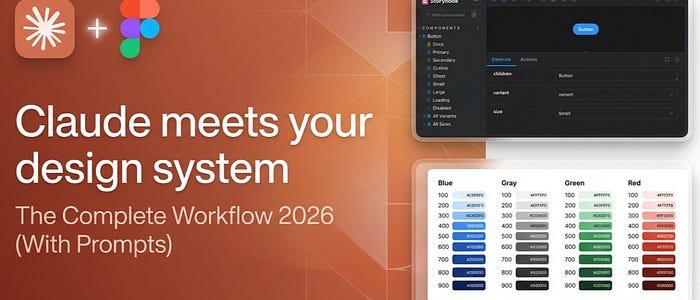
Design Systems in 2026: Claude Desktop + Figma Console MCP Full Workflow & Prompts by Garima Agarwal
Why We Like It: Exceptionally practical, prompt-first walkthrough showing a full, token-first MCP workflow that teams can copy-paste and run this week.
Hot Take: Eight-step, token-first workflow plus ready-to-use prompts and real-world tips on token limits, HTML artifacts and Storybook integration make this a must-read for teams experimenting with Claude + Figma MCP. It is rare to find an article this actionable at scale.

Specs, Not Vibes by Leo Lopes
Why We Like It: A tightly argued, system-first manifesto showing what “AI-legible” design systems actually require: exhaustive tokens, typed metadata and a single source of truth.
Don’t Miss: Leo turns the abstract claim “give the AI specs, not vibes” into concrete structure: tiered tokens, bidirectional traceability and an agent that scaffolds palettes from seeds. For leaders building systems to be consumed by models, this is essential reading.
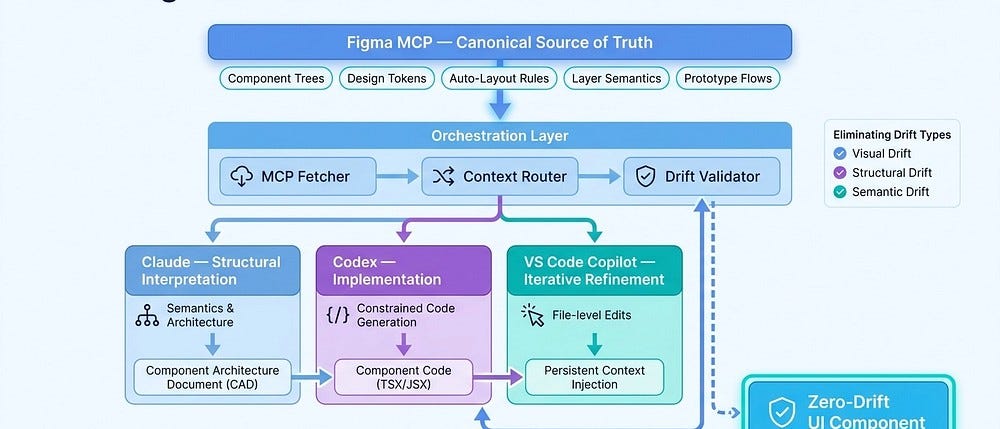
The Complete Figma MCP-to-Code Architecture: How to Orchestrate VS Code Copilot, Claude, and Codex by Vivek Ramachandran
Why We Like It: A pragmatic orchestration architecture that maps each AI tool to the work it does best and prescribes validation to prevent drift.
Pro Tip: drift in AI-assisted pipelines.
🗓️ Monthly Signals
Monthly Signals is a monthly point of view on the ideas and patterns surfacing across Design Systems Collective, what the community is actually saying and what it means.

Architecture, Not Documentation
In May, we saw a split forming in the community that hasn’t been named yet. Teams still building for human readers, and teams reckoning with the fact that the primary consumer of their system is now an agent. Read the full breakdown.
📰 Published in the Last Week
To stay updated on the latest articles, we share every new article on our LinkedIn page.
Design Systems and AI
👉 I Gave My AI Design System Ethics, Accessibility, and a Memory by Matthew Stephens
👉 My AI is fluent in design systems. Just not mine. by Tina Singh
👉 What small AI workflow experiments taught me about my design system by Tina Singh
👉 AI design system tools don’t replace yours. They make you need one urgently by Nadiia Abrosymova
👉 I made my design system LLM-readable. Here’s exactly how. by Nadiia Abrosymova
👉 AI-generated UI consistency: what breaks when you skip tokens by Nadiia Abrosymova
👉 AI-Generated Components: What to Trust, What to Fix, and What to Refuse by Madhesh P
AI Tools and Workflows
👉 Design Systems in 2026: Claude Desktop + Figma Console MCP Full Workflow & Prompts by Garima Agarwal
👉 The DESIGN.md by Chetan Singh
👉 Part 3: How to Write a DESIGN.md That AI Coding Agents Actually Follow by Ryda Rashid
👉 The Complete Figma MCP-to-Code Architecture: How to Orchestrate VS Code Copilot, Claude, and Codex by Vivek Ramachandran
Tokens and Semantics
👉 Dark Mode Is Not an Inversion. Building It Right From the Token Layer Up by Madhesh P
👉 Motion Design Tokens: Giving Your Animations a Systematic Brain by Madhesh P
👉 Design Token Drift: We Audited 375 Sites. Only 7.5% Got It Right. by Emilia BiblioKit
👉 How I Organize Colors in shadcn/ui by Sophie
👉 Why I built yet another color generator by Craig Mertan
Tooling and Process
👉 Figma Auto Layout: Stop Designing Pixels, Start Designing Rules by Wardharaheem
👉 Figma Finally Has Native Slots. Here Is the Intelligence Layer Built on Top of Them. by Surendar Selvaraj
👉 The Moment Everything Breaks: The Toggle Switch Test for Design Systems by Teng Wei Hao
👉 One Design System, Three Platforms: Web, iOS, and Android Without Losing Your Mind by Madhesh P
Governance and Strategy
👉 Architecture, Not Documentation by Shane P Williams
👉 Specs, Not Vibes by Leo Lopes
👉 You Don’t Need a Design System. You Need Design Discipline. by Carlos Fraccalvieri
Craft, Character and Taste
👉 Design Systems Solved Consistency — and Lost Character by IAMJAMES
👉 Most Websites Don’t Need More Features - They Need Better Taste by IAMJAMES
👉 The Internet Is Becoming Visually Exhausting by IAMJAMES
👉 Why Luxury Brands Understand Digital Better Than Tech by IAMJAMES
👉 Stop Building Boring Interfaces for Cool Systems by Naveen
Perspective and Opinion
👉 Intent Over Value by Shane P Williams
👉 I Flipped a Switch and Everybody Loved It by Quinton Jason Jr
👉 This Is Where It Comes Together by Gantushig Javkhlan
👉 The Hardest Brief I Ever Wrote Was for Myself by Carina B. Velasquez
👉 UI Design Systems vs Traditional UI Libraries: What’s the Difference? by Olviabatten
👉 Design Systems Explained: What They Are, Why They Matter, and How They Scale Products by Vedant
🎙️ From the Conference Floor
Stop teaching AI to pick components
At Into Design Systems 2026, Yesenia Perez-Cruz introduced a framework that’s shifted how I think about where design systems are headed. Her argument: we’ve spent years teaching AI to choose the right component. What we should be doing is giving it enough context to reason about intent.
The talk introduced two concepts, product primitives and surfaces and demonstrated, live, what happens when AI has both. The results weren’t component selections. They were design decisions.
Read the full piece and if it lands, the full session (plus 15+ hours of content from 21 speakers) is in the Into Design Systems conference recordings.
As a Design Systems Collective reader, you get 10% off. Use code DSCOLLECTIVE at checkout. Get the recordings here
🎗️ Support us:
If you find our content helpful, here’s how you can support us:
Forward this email to a friend and invite them to subscribe
Support our writers by visiting the Design Systems Collective website
📝 Closing Thoughts
The blueprints are genuinely useful. For teams integrating AI into production workflows without a machine-readable system, they offer a practical place to start. That is not a small thing.
The risk is treating machine readability as the destination. A system that an agent can consume perfectly and a system that produces genuinely good outcomes are not the same thing. The agent needs tokens, schemas and structured constraints. The quality of what it produces is a function of the quality of what went in. You cannot outsource taste to a manifest.
What tends to get lost in execution-mode thinking is that the editorial layer has never been separable from the technical one. The best systems encode decisions, not just structures. Those decisions reflect a point of view. The point of view is what the agent will eventually reproduce at scale, faithfully and without judgment.
The question is not whether your system is LLM-readable. The question is whether the judgment behind it is worth reproducing.
Founding Editor, Design Systems Collective