

Your System Can't Explain Itself. That's the Problem.
Issue #67

Most design systems are not systems. They are collections of components with a shared colour palette and a Confluence page nobody trusts. What is changing is the cost of that distinction.
When a system is genuinely a system, it can be consumed by machines, enforce its own contracts and be parsed by an agent without a designer chasing down every deviation. When it is not, it fragments. Quietly, then all at once, into agent files nobody owns, token decisions nobody documented and infrastructure that only becomes visible when something breaks.
The work at the frontier right now is not about components. It is about legibility. Can your system explain itself to an LLM without hallucinating your brand? Can your stakeholders understand it well enough to fund its maintenance before the wheels come off? These are the operational questions this community is actively working through.
The gap between a suggestion box and a contract is smaller than most teams think. The distance is mostly documentation, enforcement and intent.
In this issue
📚 Featured Articles
📊 Monthly Signals
📰 Published in the Last Week
🎗️Support us
📝 Closing Thoughts
📚 Featured Articles
Must-read articles at www.designsystemscollective.com.
💡 Have an article to share? Submit it here!
Fully Machine-Readable Design Systems by Diana Wolosin | Design Systems
Why We Like It: A rigorous, evidence‑led account of how Indeed built a layered, machine readable design system that actually prevents AI hallucination and preserves brand rhythm at scale. Essential reading for teams designing system context for LLMs.
Don’t Miss: Progressive context disclosure is the practical way to make design systems usable by LLMs. This article explains a layered plugin architecture, why foundations must be attached before components, and how to balance token cost with model accuracy so AI outputs feel and build like your product.
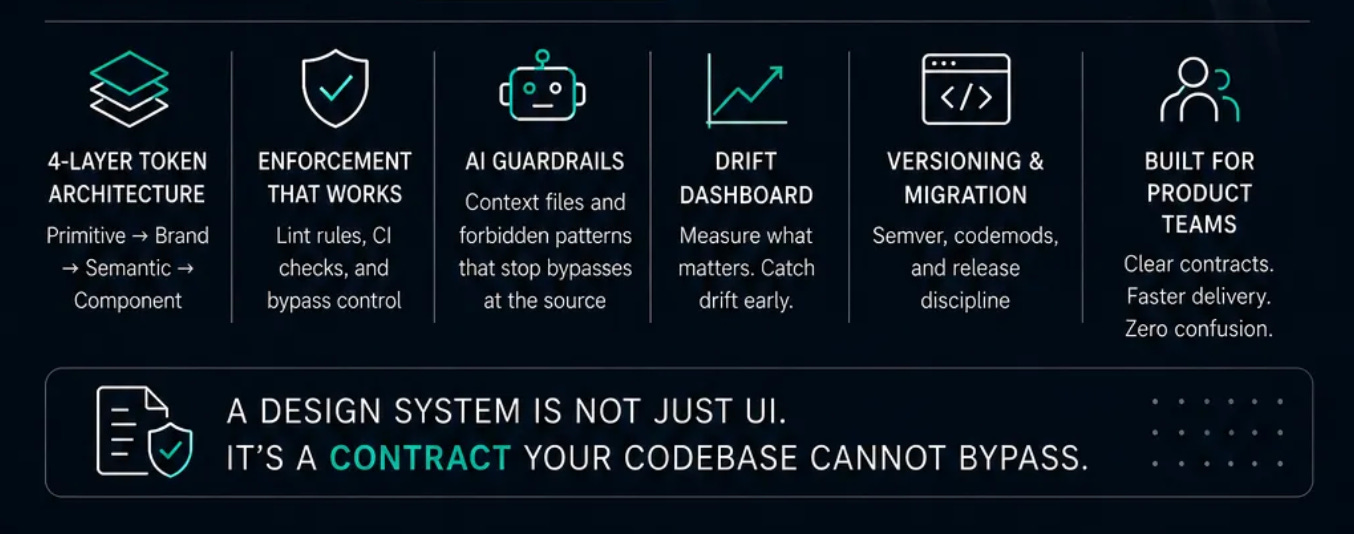
Your Design System Is a Suggestion Box. Spec Kit Turns It Into a Contract. by George William Amalan
Why We Like It:A no‑nonsense, operational playbook that turns design system intent into enforceable artefacts, CI checks and AI guardrails. If you maintain a system, this is a how‑to you will return to again and again.
Pro Tip: The Spec Kit shows concrete folder structures, lint rules, codemods, bypass registries and AI context files so you can make the wrong thing harder than the right thing. Follow the enforcement, migration and AI instructions to move from suggestion box to contract.
The Missing Language of User Interfaces by Kevin Muldoon
Why We Like It:A compelling argument for an intermediate, human‑readable layout language (Layla) that captures designer intent and compiles to multiple platforms. It reframes the design‑to‑code problem elegantly.
Don’t Miss: The article makes a strong case that Figma JSON and ad hoc formats are mirrors of tools, not of intent. A compact, readable layout language changes where truth lives in a design system and makes verification and multi‑platform compilation practical.

Your design system is fragmenting into agent files by Murphy Trueman
Why We Like It:A clear taxonomy and pragmatic roadmap for AGENTS.md, SKILL.md and DESIGN.md plus how MCP servers, Storybook manifests and governance fit together. Great operational guidance for teams adapting to agent workflows.
Hot Take: The piece explains where each agent‑facing file belongs, who should own it, and the minimum sequence of work to avoid fragmentation. Start with AGENTS.md, generate a Storybook manifest, and adopt DESIGN.md only where AI generation is routine.
📊 Monthly Signals
A monthly read on what the DSC community is writing, thinking and working through.

Every month I read the articles published on Design Systems Collective. The articles, the arguments, the quiet shifts in how the community thinks about its own work. Monthly Signals is an attempt to make sense of it. Not a roundup. A point of view on what the community is actually saying and what it means.
Here is what April told me.
📰 Published in the Last Week
To stay updated on the latest articles, we share every new article on our LinkedIn page.
AI and Agents
👉 Secrets of Claude design: Speed thrills but kills by Krishna Kanth Perumahanti
👉 The Super-Agent Illusion: Orchestrating a Multi-Agent Swarm by Krishna Kanth Perumahanti
👉 10 Guardrails that make AI development safe by The Maker’s Lab
👉 Fully Machine-Readable Design Systems by Diana Wolosin | Design Systems
👉 Your design system is fragmenting into agent files by Murphy Trueman
Tokens and Semantics
👉 Why Line Height Variables Don’t Work in Figma by Deeneesh
👉 Design Tokens Are the Most Underestimated Decision in Your Stack. by Eddie Lou
Governance and Strategy
👉 How to Position System-Level Design Work So It Actually Gets Funded by Shadi Abd
👉 Versioning Your Design System Without Breaking Everyone’s Heart by Madhesh P
👉 Your Design System Is a Suggestion Box. Spec Kit Turns It Into a Contract. by George William Amalan
👉 How to Measure If Your Design System Is Actually Working by Madhesh P
👉 The Infrastructure Nobody Sees by Shane P Williams
Building and Maintaining Systems
👉 How to Maintain a Design System by Hriday Checker
👉 Building a Design System from Scratch by German Quinteros
👉 The Parts Work. The System Doesn’t. by Gantushig Javkhlan
👉 Design System Challenges by Carlota Antón
👉 Design Systems vs Templates vs Style Guides (A Clear Explanation) by Hriday Checker
Accessibility and Inclusion
👉 Accessibility Is No Longer Optional. It Never Was. by Eddie Lou
Perspective and Opinion
👉 No, UX Design Isn’t Dead. But Almost Everything About How It’s Practiced Just Changed. by Abhi Chatterjee
👉 The Parts Work. The System Doesn’t. by Gantushig Javkhlan
👉 Articulation is design craft by Cristian Morales Achiardi
👉 The Missing Language of User Interfaces by Kevin Muldoon
Tooling and Process
👉 Constraints Before Tools: Designing a Keyboard‑First Mind‑Mapping Experience by Kornel Maráz
👉 What the Double Diamond Design Process Teaches You About Solving the Right Problems by Allclonescript
👉 Design Systems in UI: The Secret Behind Great Digital Products by Allclonescript
🎗️ Support us:
If you find our content helpful, here’s how you can support us:
Forward this email to a friend and invite them to subscribe
Support our writers by visiting the Design Systems Collective website
📝 Closing Thoughts
There is a pattern across the writing in this issue worth naming: making things legible is the work. Not the components, not the tokens. The act of articulating what a system is, what it does and what it expects of the people and processes that consume it.
The AI pressure is not changing that problem. It is exposing it. A machine-readable design system is not a new concept. It is just a well-documented one, finally being asked to prove it.
The teams that build well in the next few years are not the ones with the most sophisticated tooling. They are the ones who made their systems legible before the agents arrived and started reading.
Founding Editor, Design Systems Collective